
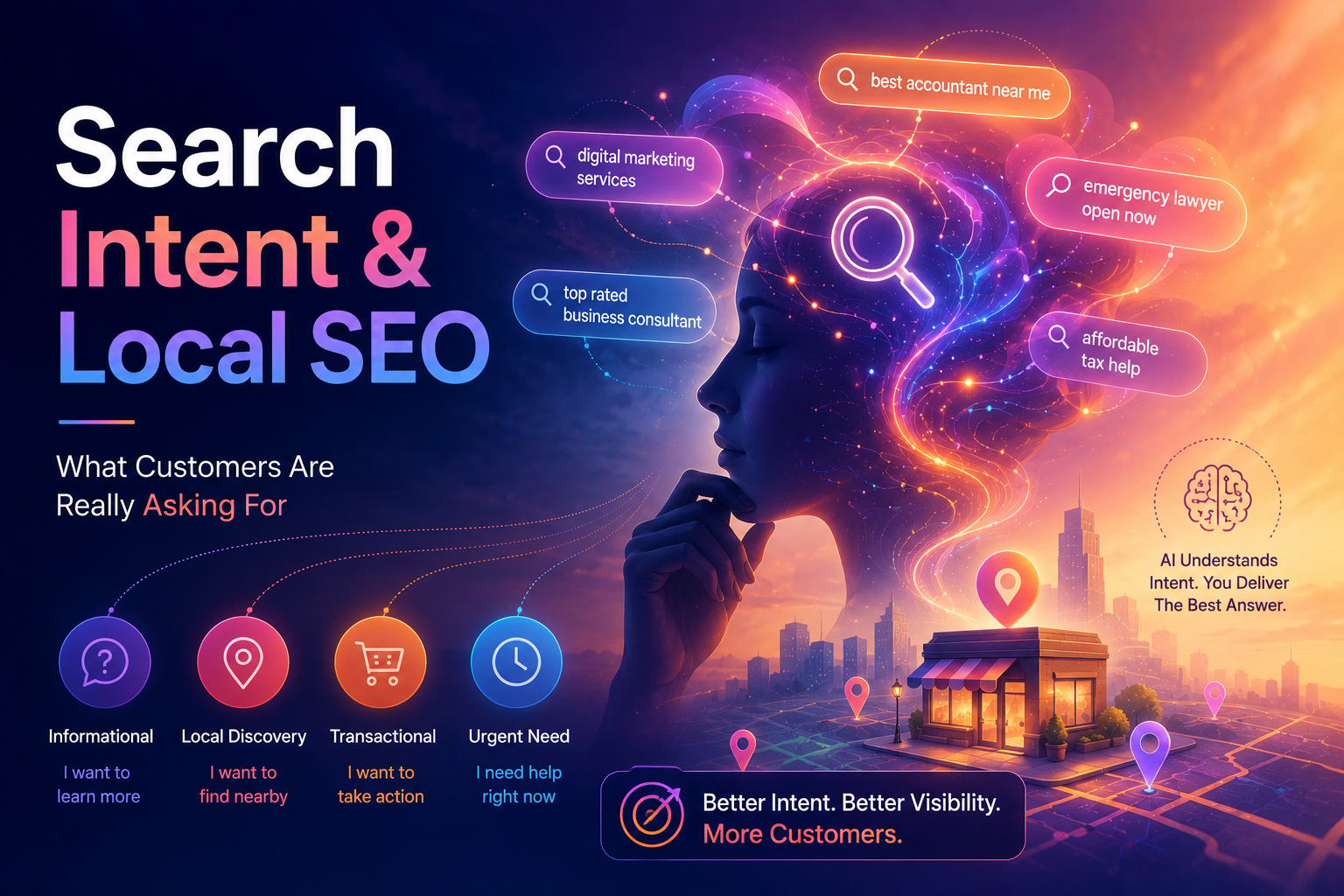
Matching your content to search intent not just keywords is the key to local SEO success in 2026. Learn how to decode intent signals and create content that ranks and converts.
One of the most significant evolutions in modern search engine optimization is the shift from keyword matching to intent matching. Early SEO was largely about density how many times a target keyword appeared on a page. Modern local SEO, particularly in 2026, is about understanding the underlying purpose the intent behind every search query, and creating content that fulfills that intent completely.
Search intent falls into four primary categories for local businesses. Navigational intent is when someone is looking for a specific business they already know (“Biz Search Flow login”). Informational intent is when someone is researching a topic (“how much does a kitchen renovation cost in Dallas”). Commercial investigation intent is when someone is comparing options before making a decision (“best HVAC companies in Houston reviews”). Transactional intent is when someone is ready to act (“emergency HVAC repair service Houston open now”).
For local businesses, transactional and commercial investigation intent queries are the highest-priority targets. These are the queries made by people who are ready to hire, buy, or book and the businesses that appear most prominently for these queries capture the vast majority of local search revenue.
Aligning your content with transactional intent means being explicit about your availability, your service offering, and what the next action should be. For “emergency HVAC repair Houston,” your listing and landing page should immediately communicate that you offer emergency service, that you’re available now, what areas you serve, and how to contact you all above the fold, all without requiring the searcher to hunt for it.
For commercial investigation intent queries, your content should help consumers make confident decisions. Comparison content, detailed service descriptions, transparent pricing ranges, and case studies all serve the commercial investigation searcher effectively building the trust that converts consideration into contact.
Matching keyword research to intent is a practical skill. Look at the modifiers in your target queries: “best,” “near me,” “open now,” “reviews,” “cost,” “how to” each modifier signals a different intent state. Organize your content strategy around these intent signals to ensure every piece of content you create serves a clearly defined customer need.
Frequently Asked Questions
Q: How does Google determine the intent behind a search query?
A: Google uses machine learning models trained on billions of searches to classify the likely intent behind any given query. It examines the query’s structure, its modifiers, historical click-through patterns, and contextual signals like location and device type to determine which type of content best matches the searcher’s intent.
Q: Should I create separate pages for different intent stages?
A: Yes, in many cases. A service overview page serves commercial investigation intent; an emergency or same-day service page serves transactional intent; a cost guide or FAQ page serves informational intent. Each page can be optimized for the specific signals that resonate with its target intent stage.
Q: How does intent optimization relate to AEO?
A: AEO is essentially the specialized application of intent optimization for question-format queries. When you optimize your content to directly answer specific user questions matching both the question’s wording and its underlying intent you’re simultaneously doing AEO and intent-based SEO. Both strategies reinforce each other.