
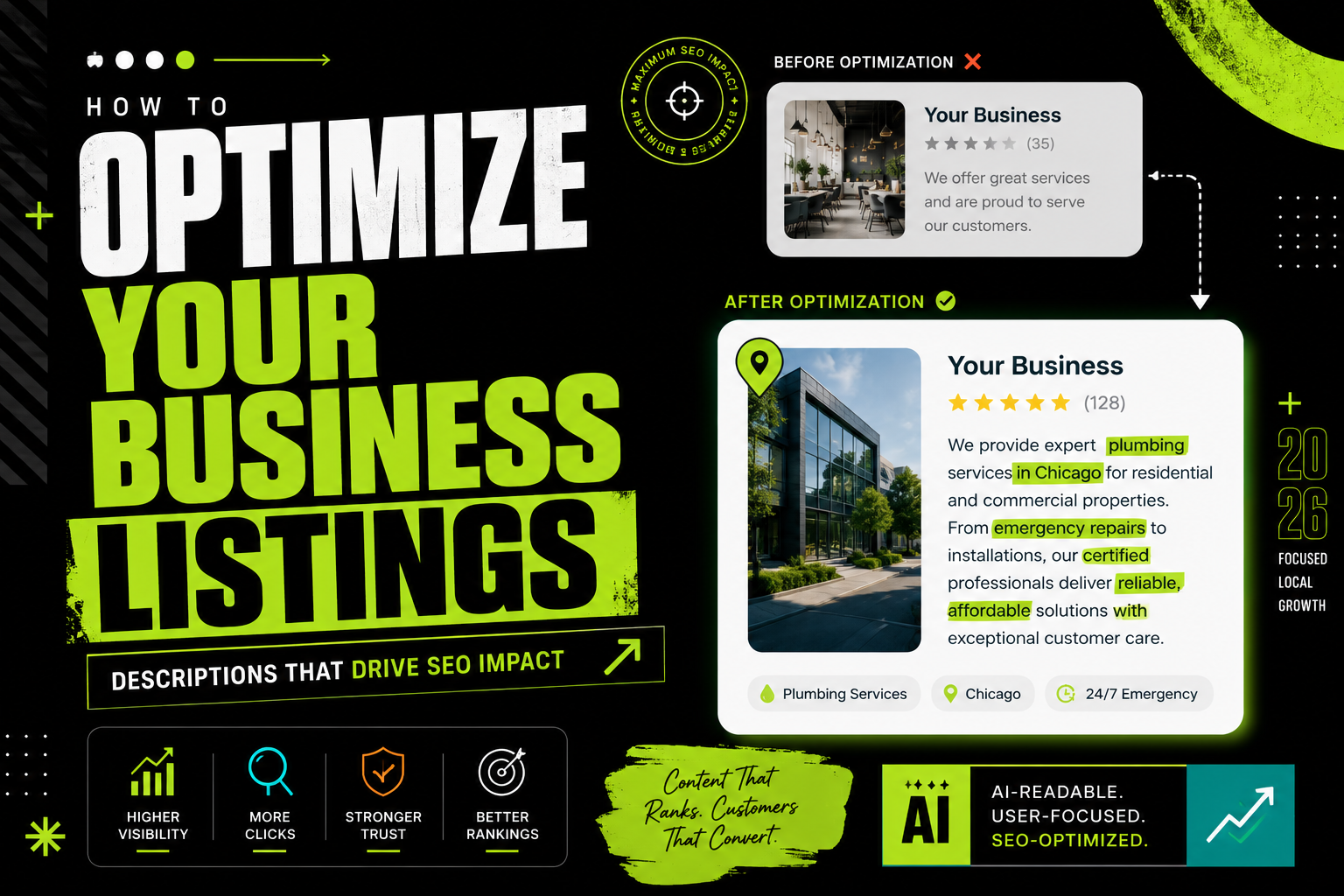
Your business listing description is one of the most underutilized local SEO assets. Learn how to write descriptions that rank well, attract the right customers, and contribute to AI-era visibility.
Your business listing description the text field that tells consumers what your business does, who it serves, and why they should choose you is one of the most overlooked optimization opportunities in local SEO. Most business owners write a brief, generic blurb and move on. The businesses that treat their listing description as a strategic SEO asset consistently capture more visibility, more clicks, and more conversions than their less thoughtful competitors.
An optimized listing description serves three simultaneous purposes: it communicates your value proposition to human readers, it provides keyword-relevant content to search engine crawlers, and it supplies structured descriptive text that AI systems can extract and present when composing business recommendations.
Writing for all three audiences requires balancing natural, engaging language with strategic keyword inclusion. Your description should open with your primary service offering and geographic service area the two most important contextual signals for local search relevance. Follow this with specific differentiators: years in business, specializations, certifications, unique service offerings, or notable achievements that set you apart from competitors in your category.
Keyword integration should be natural and conversational, not mechanical. Include your primary service keyword, your city and key neighborhoods, and relevant descriptor terms (licensed, insured, certified, same-day service, free estimates, etc.) in language that reads naturally to a human consumer. Read your description aloud if it sounds like a keyword list rather than a business pitch, rewrite it.
For AI optimization, structure your description to answer common questions directly. “We are a licensed HVAC contractor serving the greater Denver metropolitan area, specializing in energy-efficient system installation, emergency repairs, and preventive maintenance for residential and light commercial clients” directly answers “what do you do,” “where do you serve,” and “who are your clients” the three questions AI systems most commonly need to answer when evaluating whether to recommend a business.
Length matters. Most directory platforms allow 500 to 1000 characters for listing descriptions. Use most of this space descriptive, specific content consistently outperforms brief, generic descriptions in both search ranking and click-through rates.
Frequently Asked Questions
Q: How often should I update my business listing description?
A: Review and refresh your descriptions at least twice per year, and immediately whenever you add a significant new service, earn a new certification, or change your service area. Regular updates signal business activity to both search engines and potential customers.
Q: Should my listing description on different platforms be identical?
A: Your core NAP information must be consistent, but your descriptions can and should be adapted slightly for each platform’s character limits and audience. Unique descriptions also prevent duplicate content issues. Keep the key service information and differentiators consistent while varying the phrasing.
Q: Does including pricing information in my listing description help or hurt?
A: For most businesses, referencing a pricing structure (e.g., “free estimates,” “flat-rate pricing,” “competitive rates”) without specific price points is beneficial it addresses a common consumer concern. Specific pricing is appropriate for businesses in categories where price transparency builds trust, such as cleaning services or standard professional consultations.