Organic local SEO and paid search are most powerful when used together. Learn how to integrate these two channels for maximum visibility, lower cost-per-acquisition, and sustainable local market dominance.
Local business owners often frame the SEO versus paid search question as an either/or choice. In reality, the most successful local businesses treat organic SEO and paid local search advertising as complementary channels that reinforce each other delivering better results together than either could achieve alone.
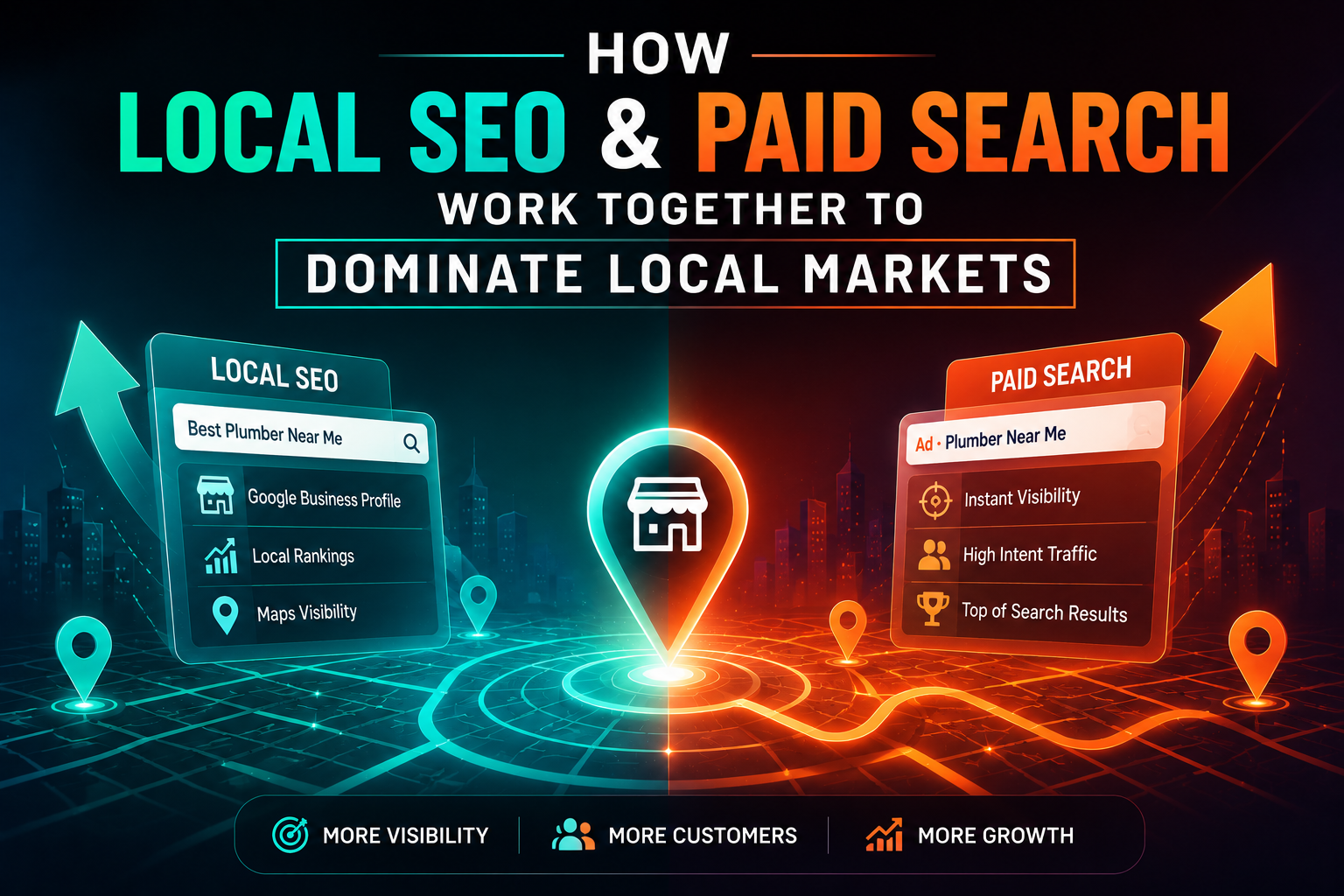
The fundamental dynamic is simple: SEO builds long-term organic visibility that costs less per click over time; paid search delivers immediate, controllable visibility for specific high-intent queries. Used together, they allow businesses to capture nearly the full spectrum of local search demand showing up in organic results, the local three-pack, and paid ads for the same set of queries.
Research consistently shows that consumers who see a business in both organic results and paid ads are more likely to click and convert than those who see either channel alone. This “double presence” effect amplifies brand credibility and builds the impression of market dominance that influences consumer choice.
Paid search data is also one of the most valuable inputs available for SEO strategy. Your Google Ads data shows exactly which keywords drive phone calls, conversions, and qualified traffic for your specific business often in as little as a few weeks of campaign data. This conversion data directly informs which keywords to prioritize in your organic SEO content, dramatically shortening the research and testing cycle compared to purely organic keyword research.
For businesses in early SEO development, paid search can bridge the visibility gap during the six to twelve months it typically takes for organic rankings to mature. Rather than waiting for organic rankings to develop while generating no local search traffic, a modest paid campaign on your highest-intent local keywords maintains lead flow while your organic foundation develops.
Smart budget allocation across both channels is a function of your organic ranking status. For keywords where you rank organically on page one, paid ads add incremental value at a cost that must be weighed against the organic conversion rate. For keywords where you don’t yet have organic visibility, paid ads are your only presence and often worth the investment to capture high-intent traffic you’d otherwise miss entirely.
Frequently Asked Questions
Q: What’s the ideal budget split between SEO and paid search for a local business?
A: There’s no universal answer it depends on your category competition, your current organic ranking status, and your revenue goals. A common framework is to invest more heavily in SEO for long-term compounding value, with paid search used tactically to capture high-intent keywords where organic rankings are weak or to test new service offerings quickly.
Q: Does running paid ads affect my organic local SEO rankings?
A: No. Google explicitly states that paid advertising does not influence organic rankings. The benefits of combining both channels come from the behavioral and visibility effects on consumers not from algorithmic preferencing of advertisers.
Q: How do I measure the combined ROI of SEO and paid search together?
A: Track all contact channels GBP calls, website form submissions, paid ad conversions, and direct contacts from directory listings and attribute each to its source using UTM parameters and call tracking numbers. This cross-channel attribution gives you an accurate picture of total local search ROI.